
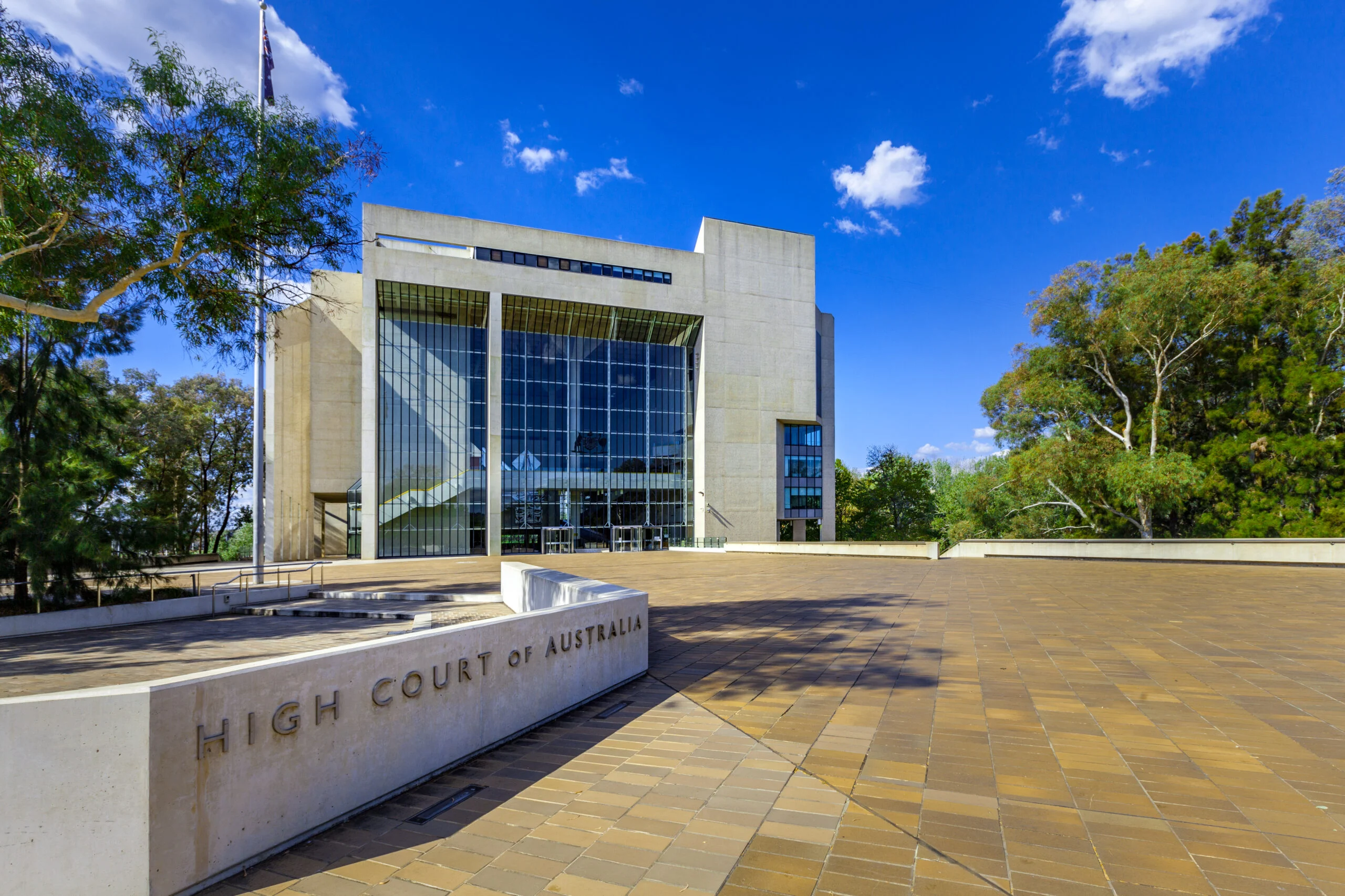
High Court Appeal (Judgment): AA v The Trustees of the Roman Catholic Church for the Diocese of Maitland-Newcastle ABN 79469343054 – Case S94/2025
Published on February 25, 2026 by Luca Circosta, Jackson Gilbert and David Nair
Introduction
This article is intended as part of a series reporting on both the decision at first instance (link below) the submissions before the High Court (link below) and ultimately the High Court decision handed down on 11 February 2026. We provide below the findings of the Court, and the current landscape of duty of care and non-delegable duties of care.
Background
On 7 August 2025, the High Court of Australia heard the matter of AA v The Trustees of the Roman Catholic Church for the Diocese of Maitland-Newcastle ABN 79469343054 – Case S94/2025.
This was an appeal by AA (pseudonym) of a decision of the New South Wales Court of Appeal handed down on 15 April 2025 (CODEA Case Summary).
The plurality of the High Court surmised that the ultimate issue in the appeal was whether the Respondent to the proceedings, The Trustees of the Roman Catholic Church for the Diocese of Maitland-Newcastle (the Diocese), were liable to the Appellant (AA), for harm AA suffered at the hands of Fr Ronald Pickin, a priest performing the function of a parish priest at a parish within the geographical area of the Diocese.[1]
The broader and anticipated points of law that arose from the ‘ultimate question’ the High Court grappled with were set out by the Respondent in submissions, of which were:
- Did the Diocese, in the provision of religious instruction or pastoral care at the relevant dates in the 1960s, owe a duty to AA to take reasonable care to avoid AA suffering personal injury in the form of sexual assault?
- If yes to (1), should New South Wales v Lepore (2003) 211 CLR 512 (Lepore) be reopened and if so, overruled? (Can a non-delegable duty exist in respect of harm caused by an intentional criminal act)
- If yes to (2), was the scope of the duty of care “non-delegable” in the sense of extending to a duty to ensure reasonable care was taken to avoid AA suffering personal injury in the form of sexual assault?
Court’s Findings
In answer to points (1) through (3) outlined above, the plurality of the High Court held that the Diocese is liable to AA for breach of a non-delegable common law duty of care it owed to AA in 1969. The duty the Diocese owed to AA in 1969 was a duty to a child to ensure that while the child was under the care, supervision or control of a priest of the Diocese, as a result of the priest purportedly performing a function of a priest of the Diocese, reasonable care was taken to prevent reasonably foreseeable personal injury to the child.
The Appeal was therefore allowed, and it was held by the majority, that the Diocese breached its non-delegable duty owed to AA and awarded damages, varied from damages $636,480.00 at first instance, to $335,960.00 pursuant to the provisions of the Civil Liability Act
Lepore and Non-Delegable Duty
In short, the decision reached in Lepore was such that “a non-delegable duty of care cannot extend to a duty to ensure reasonable care is taken to protect a person from an intentional criminal act.”[3]
The High Court sets out from paragraphs [31]-[50] its reasons for overturning the above principle in Lepore which the majority considered that Lepore today does not provide consistency with legislative development and the interpretation of non-delegable duty and would continue to stifle it’s place at common law, which at the time of Lepore, this scope was confined so as to not encroach on the principles of vicarious liability. [4]
In distinguishing the two avenues of incurring liability, the High Court stated that in a non-delegable duty of care, the pre-condition is the existence of a relationship of the relevant kind and the harm being of a foreseeable kind within the scope of legal responsibility created by the relationship. As to vicarious liability, the pre-condition is the act causing harm being within the course of the employee’s employment.[5] The High Court points out that neither avenue of incurring liability required the act causing harm to be an intentional criminal act.[6]
Non-Delegable Duty
In specific contemplation of whether the scope of the duty of care was “non-delegable” in the sense of whether the provision of religious instruction or pastoral care at the relevant dates in the 1960s, meant a duty was owed to AA to take reasonable care to avoid AA suffering personal injury in the form of sexual assault, the High Court found that a non-delegable duty is to be recognised because no principled basis to distinguish the position of the Diocese in 1969 from that of a school authority at that time is discernible.
In essence the High Court found that the position of the Diocese in 1969 could not be distinguished from a school authority, and as Mason J explained in Commonwealth v Introvigne,[7] a “school authority owes to its pupil a duty to ensure that reasonable care is taken of them whilst they are on the school premises during hours when the school is open for attendance”,[8] being “a duty the performance of which cannot be delegated”.[9]
The High Court noted with reference to Commonwealth v Introvigne that the source of the non-delegable duty included that the “immaturity and inexperience of the pupils and their propensity for mischief suggest that there should be a special responsibility on a school authority to care for their safety, one that goes beyond a mere vicarious liability for the acts and omissions of its servants”.[10]
In framing the scope of the Diocese’s non-delegable duty, the High Court stated that “the non-delegable duty of care should be framed so that it directly ties the fact of the child being under the care, supervision or control of a priest of the diocese to the circumstance of the priest having purportedly performed a function of a priest of the diocese”.[11]
On the question of whether AA came under the care, supervision or control of a priest of the Diocese, the High Court answered in the affirmative. This was because it was the relationship between the Diocese and AA that enabled Fr Pickin, as a priest of the Diocese performing the functions of parish priest, to meet AA [at Wallsend High School and instruct him on the catholic faith] and to invite AA to the presbytery and resulted in AA accepting that invitation and AA’s parents permitting him to go.[12] The determinative factor was how the child came to be under the care of a priest, [13] not whether the assaults occurred during the course of a ‘church event’.[14]
Foreseeability
Subsequently for breach to be found, the harm must be reasonably foreseeable personal injury to the child.[15]
In breaching the non-delegable duty, the High Court explained that the relevant risk of AA suffering harm whilst under the control, care and supervision of a priest of the Diocese (Fr Pickin), and a risk of this harm was reasonably foreseeable.[16] The fact that the circumstances of this case involved an intentional criminal act by a delegate, would establish that the delegate failed to take reasonable care and that the duty holder failed to ensure that reasonable care was taken.[17]
In the Court of Appeal, Leeming JA observed that absent any direct knowledge that the priest posed a risk to children, he did not see how the Diocese could owe a duty of care to AA.
The High Court was satisfied that, to meet the threshold of risk being reasonably foreseeable it was enough that on a constructive knowledge basis, the Bishops of the Diocese were aware of a general risk of a priest sexually abusing a child by 1969.[18]
To satisfy whether the risk was reasonably foreseeable, the High Court evaluated the evidence and reasoning before the Primary Judge at trial at paragraphs [82] to 100]. The High Court considered that the primary Judge’s key findings were sufficient to establish a not far-fetched or fanciful risk of harm of a priest of a diocese sexually abusing a child in 1969.
The High Court considered that the weight of Fr Dillon’s expert liability evidence was correctly understood at first instance; being that, by 1969, the risk of harm to children by priests was generally known amongst high-ranking members of the Church, including Bishops, Religious Superiors and Provincials.[19] Fr Dillon’s evidence did not suggest that every Bishop knew of this risk, but the evidence was considered relevant to suggest that the class of “Bishops”, as a whole ought to have been able to reasonably foresee and ought reasonably to know at the time, that there was a risk of harm of priests sexually abusing children in 1969,[20]
The Court considered that actual knowledge of an allegation from some Bishops supports the inference of constructive knowledge attributable on the part of all Bishops, with the assumption that each Bishop does not operate in isolation from one another and ought to have known of the general risk.[21]
Fr Dillon’s evidence also spoke to the general duties and authority of priests by 1969, including their level of autonomy and the general understanding of what was appropriate interaction with children, including interactions one-on-one as being uncommon. Fr Dillon, despite being an ordained priest in Victoria, was accepted on his evidence and experience as being relevant to the generally accepted operation, management and training of priests and parishes across Australia.[22]
The evidence on the functions and operation of the parishes and priests, in conjunction with the evidence on knowledge was taken to establish that Bishop’s ought to have known that in performing the functions of a parish priest, a risk of harm is created and therefore reasonably foreseeable; in this case it was taken that Diocesan Bishop Toohey’s inferred approval and authorisation of Fr Pickin was taken to have been a foreseeable risk. [23]
This combination of circumstances was determined by the High Court to be sufficient to establish a not far-fetched or fanciful risk of harm of a priest of a Diocese sexually abusing a child in 1969, which ought to have been reasonably foreseeable by the Class of Bishops of Diocese in Australia.[24]
Third Parties
As a further matter, the High Court did not confine the non-delegable duty to personal injury caused by the conduct of the delegable, but it also extended to the conduct of the delegable which intentionally permits a third party to injure the child.[25]
The High Court considered that there was no difference between a delegate’s failure to take reasonable care by assaulting a child and a failure on the part of the delegate to take reasonable to prevent injury by a third party.
Damages
The High Court also clarified the proper process for the assessment of damages in NSW. Ultimately, the Court concluded:
- If breach of a non-delegable duty of care is established, the damages would be assessed under the Civil Liability Act 2002 (NSW) and there would be limits imposed on non-economic loss, and interest;
- If the Defendant is not found to be vicariously liable for the conduct of its employee, then damages would also be assessed under the Civil Liability Act 2002 (NSW); and
- If the Defendant is found to be vicariously liable for the conduct of its employee, damages will be assessed at Common Law, and the restrictions on damages found in the Civil Liability Act 2002 (NSW) do not apply.
Conclusion
The effect of the decision is that a non-delegable duty may result in liability being imposed on an institution (the duty holder) without personal fault on the part of the institution. The mere fact that an assault has been perpetrated by a delegate (in this case, the priest) could be considered a failure to take reasonable care to avoid a foreseeable risk of injury to the person to whom the institution owes the non-delegable duty.
Importantly, the decision will likely re-open the door for survivors to pursue claims arising from a breach of a non-delegable duty of care arising from the criminal acts of non-employees, if the required features of a non-delegable duty of care and breach exist. Many of these types of claims (abuse by non-employees) were previously precluded by reason of the High Court’s decision in Bird v DP (2024) 98 ALJR 1349 which considered that vicarious liability could not imposed on an institution absent an employment relationship.
The High Court also made clear that institutions can still take steps to protect themselves from potential liability by taking reasonable steps to ensure the care of children. The institution will only be liable if it or its delegate has failed to act with reasonable care and that failure has caused the harm.
The Decision has set out in clearer terms the test in identifying whether a Defendant will be said to owe a non-delegable duty, the grounds for breaching this duty; as well as a re-evaluation of the principles in Lepore and an extension of this duty to not only negligent acts but intentional criminal acts of a Defendant’s delegate or third parties.
This case additionally sets out the impact and weight of expert liability evidence in establishing the circumstances where a risk of harm will be considered reasonably foreseeable. It is likely that evidence on the constructive knowledge of the duty-holder and the operation and function of its delegates will be highly relevant to satisfying this test and attributing liability to the duty holder in failing to ensure care was taken by its delegate or third parties.
(A summary of the Primary Judgment and New South Wales Court of Appeal decision can be found here)
(A summary of the key issues in dispute heard at the High Court Appeal can be found here)
[1] AA v Trustees of the Roman Catholic Church for the Diocese of Maitland-Newcastle [2026] HCA, [1].
[2] Civil Liability Act 2002 (NSW), s 16.
[3] AA v Trustees of the Roman Catholic Church for the Diocese of Maitland-Newcastle [2026] HCA, [32].
[4] Ibid, [47]-[50].
[5] Ibid, [48].
[6] Ibid.
[7] (1982) 150 CLR 258.
[8] (1982) 150 CLR 258 at 269, Gibbs CJ agreeing at 260 and Murphy J reaching the same view at 274.
[9] (1982) 150 CLR 258 at 270.
[10] AA v Trustees of the Roman Catholic Church for the Diocese of Maitland-Newcastle [2026] HCA [15], citing Commonwealth v Introvigne (1982) 150 CLR 258 at 271.
[11] Ibid, [114].
[12] Ibid, [115].
[13] Ibid, [116].
[14] Ibid, [97].
[15] Ibid, [121].
[16] Ibid, [145].
[17] Ibid [30].
[18] Ibid [99]-[100]
[19] Ibid [88]-[89]
[20] Ibid [90].
[21] Ibid [90]
[22] Ibid [87].
[23] Ibid [97].
[24] Ibid [100].
[25] Ibid [120].
This article was published on 23 February, 2026 by Carroll & O’Dea Lawyers and is based on the relevant state of the law (legislation, regulations and case law) at that date for the jurisdiction in which it is published. Please note this article does not constitute legal advice. If you ever need legal advice or want to discuss a legal problem, please contact us to see if we can help. You can reach us on 1800 301 601 or via the Contact us page on our website. (www.codea.com.au). If you or a loved one has been injured, use our Personal injury Claim Check now.