
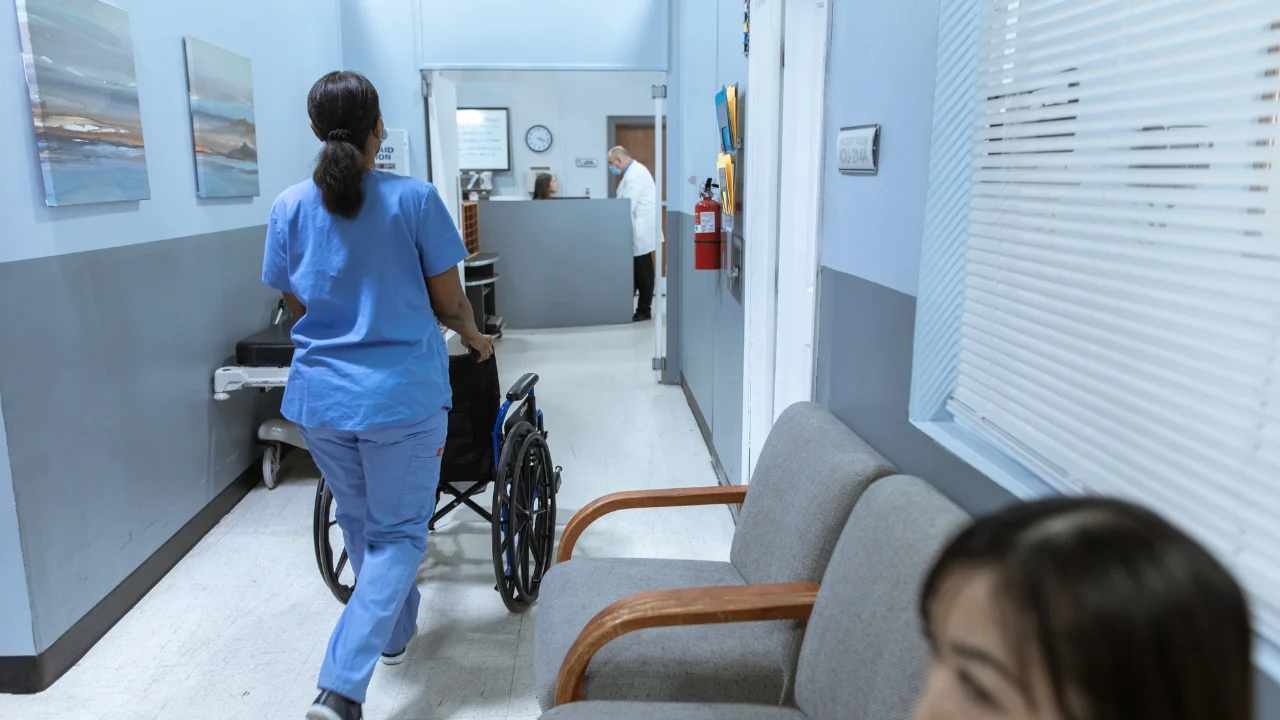
Nurse and Healthcare Workers Injured While Caring for a Patient
Published on September 2, 2026 by Iain Miller
Nurses and other healthcare workers who suffer injuries while caring for patients in hospitals, aged care facilities, or other clinical settings often ask whether their employer may be legally responsible for the harm they have suffered.
These injuries commonly arise when assisting high-dependency patients, particularly patients with cognitive impairments, dementia, psychiatric conditions, or behavioural issues that can make their actions difficult to predict. Manual handling incidents, patient restraints, falls prevention activities, and responding to sudden patient movements can all expose nursing staff to significant risks of injury.
Whether a successful compensation claim can be pursued will depend on the circumstances of each case, including the systems of work that were in place and the steps taken by the employer to manage foreseeable risks.
Employers’ and Operators’ Duty of Care to Nursing Staff
Employers and operators of hospitals and healthcare facilities owe a duty to take reasonable care to avoid exposing nurses and other staff to unnecessary risks of injury while performing their duties, including when caring for patients.
Very generally, a Court will need to consider whether the risk of harm to which a person was exposed:
- Was foreseeable;
- Not insignificant; and
- A reasonable person in the position of the employer or operator of the hospital would have taken precautions against that risk of harm
Importantly, when devising and implementing a safe system of work, the employer/operator is obliged to take into account the possibility that there might be episodes of inadvertence or divergence from self-care by a healthcare worker when concentrating on and carrying out the required tasks.
This is particularly relevant where nurses are required to assist patients with complex needs or unpredictable behaviour.
What do the Courts Consider?
A number of recent decisions provide guidance on the circumstances in which hospitals may be liable for workplace injuries sustained by nursing and healthcare workers.
Importantly, they also show that the assessment is not limited to what a nurse did or did not do at the time of the incident. Courts will closely examine whether the employer/operator had appropriate risk management systems, staffing levels, training, supervision, and equipment in place before the injury occurred.
- Smith v Sydney West Area Health Service [2008] NSWCA 267. This involved an injury to a nurse during a two-person transfer of an elderly patient. One of the nurses assisting with the transfer moved away from patient, who then lost balance causing the remaining nurse to bear the patient’s entire weight resulting in an injury. The NSW Court of Appeal confirmed that the risk of the patient, described as large, “frail and doddery” man, falling or losing balance during a transfer as reasonably foreseeable.
- Downes v Affinity Health Pty Ltd [2015] QDC 197. This involved an injury to a nurse while she attempted to prevent a patient from falling and then lifting the patient back into the centre of her bed. The Court recognising that patient assessments are also to identify risks the patient’s present during nursing care, and not just in relation to clinical needs.
- Armstrong-Waters v State of Queensland [2020] QDC 66. This involved a registered nurse in an emergency department of a regional hospital, who suffered injury when she was attacked by a patient in the ED. The Court found that the employer breached its duty of care by failing to provide adequate security staffing in the ED, as well as failing to provide sufficient training on managing aggressive behaviour.
- Wilson v Gold Coast Hospital and Health Service [2023] QSC 135. This involved an injury to a registered nurse, who was injured at work while taking part in the restraint of a patient with dementia, who had been difficult, disruptive, acting out physically, and refusing medication. Part of the nurse’s allegations were that she ought to have been instructed to leave the restraint of the patient to security officers rather than getting involved herself.
Evidence that May be Critical to a Claim
These decisions demonstrate the importance of obtaining evidence relating to how a hospital identified and managed risks associated with working in a particular clinical setting, as well as specific risks that are associated with any individual patient.
Relevant evidence may include:
- Documents setting out the system of work and compliance with the relevant work health and safety legislation, as well as any inductions prior to commencing in a particular ward or unit.
- Rosters and other records demonstrating the availability of nursing and support staff at the time of the injury, as well as information confirming the staff to patient ratios.
- Records relating to the risk/falls assessment of a particular patient, including whether the patient had demonstrated impulsive or violent behaviour prior the injury.
- Records in relation the training for manual handling of patients, clinical handover, systematic assessments, teamwork and documentation, human factors, work health and safety, care co-ordination, and hazardous manual handling.
- The availability of assistive aids and equipment such as mechanical lifting devices, hoists, slide sheets, transfer aids and other specialised patient handling equipment.
Key Takeaways
Manual handling and patient-related injury claims involving nurses and healthcare workers are often complex and highly fact-specific.
Courts will closely examine both the overall system of work implemented by the employer and operator of a hospital, and the management of risks associated with particular patients.
Many of the same principles also apply to claims involving patients who suffer injury due to inadequate risk assessments or failures to implement appropriate safety controls.
If you have suffered an injury while working as a nurse or healthcare professional, obtaining early legal advice can assist in identifying whether a negligence claim may be available, in addition to any workers compensation entitlements.
Disclosure and important note: This article is based on our own legal research and thinking. Some of its content has been drafted with the assistance of artificial intelligence. The authors have checked and approved this article, including the AI generated content, for publication.
This article was published on 2 of September 2026 by Carroll & O’Dea Lawyers and is based on the relevant state of the law (legislation, regulations and case law) at that date for the jurisdiction in which it is published. Please note this article does not constitute legal advice. If you ever need legal advice or want to discuss a legal problem, please contact us to see if we can help. You can reach us on 1800 059 278 or via the Contact us page on our website. (www.codea.com.au). If you or a loved one has been injured, use our Personal injury Claim Check now.
